
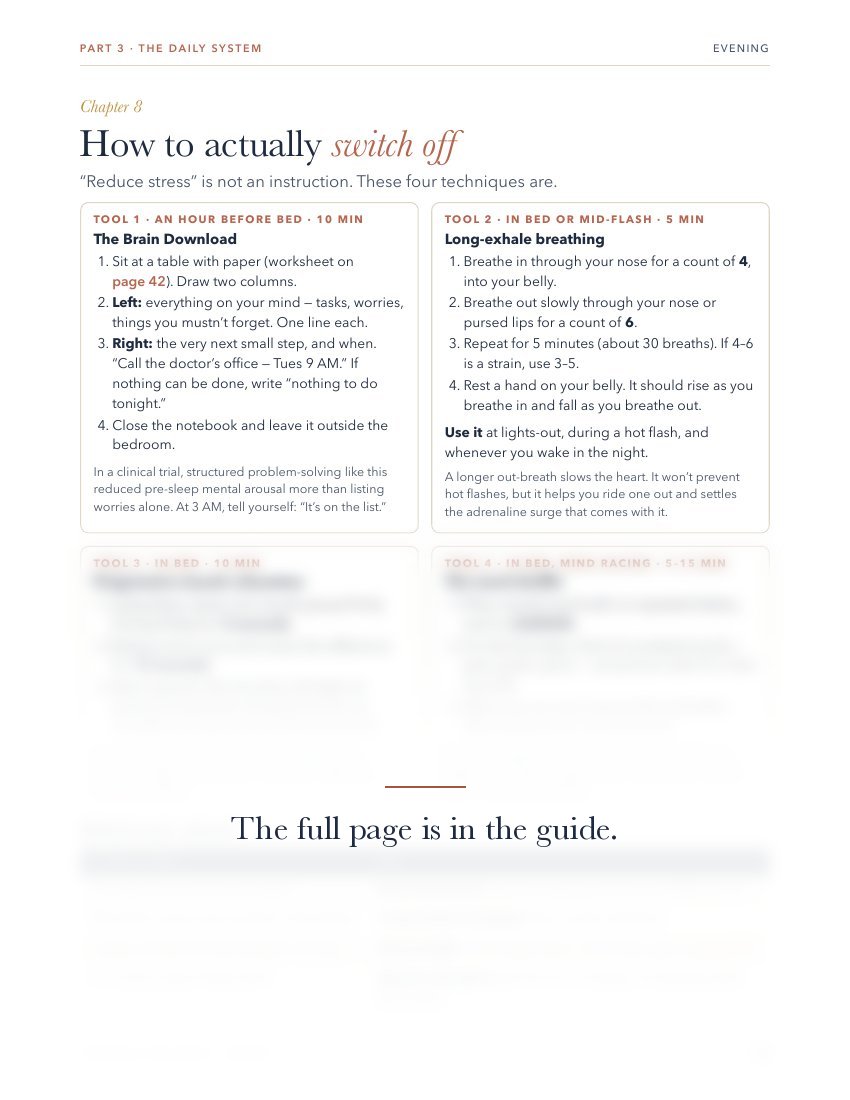
A breathing exercise to fall asleep: in for 4, out for 6.
No app, no special technique, nothing to buy. Breathe in for a count of 4 and out for a count of 6. Here’s how to do it well, when to use it, and why the out-breath is the part that matters.

You’re in bed, the lights are off, and your body hasn’t got the message. Your shoulders are up, your jaw is tight, and your heart is going a little faster than it should for someone lying still. Your mind is happy to fill the silence.
Of all the things you can do about that, slow breathing is the simplest. It takes no equipment, you can do it with your eyes closed, and it works the same at 10 PM, at 3 AM and halfway through a hot flash. The version that tends to work best has one rule: the out-breath is longer than the in-breath.
How to do it
- Get comfortable and rest a hand on your belly. Lying on your back or your side is fine. The hand is there so you can feel what’s happening.
- Breathe in through your nose for a count of 4. Let the air go low, into your belly, so your hand rises. Your chest should barely move.
- Breathe out slowly for a count of 6. Through your nose, or through softly pursed lips, as if you were cooling a spoonful of soup. Your hand falls.
- Keep going for about 5 minutes. That’s roughly 30 breaths. You don’t need to count them; count the 4 and the 6.
- Too much? Use 3 and 5. If 4 and 6 leaves you straining or gulping for air, shorten both counts. What matters is that the out-breath is longer, not how long either one is.
The counts don’t need to be seconds. Count at whatever pace feels slow and easy for you. At an unhurried pace, 4 in and 6 out comes to about six breaths a minute, which is why five minutes is roughly 30 breaths.
Why the out-breath does the work
Your heart rate rises a little every time you breathe in and falls a little every time you breathe out. Make the out-breath longer and you spend more of every minute in the slowing-down half. That’s why a long exhale slows the heart, and why it tends to calm a body that’s wound up.
There’s a second reason it helps at night. Counting gives your mind a small, boring job. It’s hard to rehearse tomorrow’s meeting while you’re also counting to 6, and every time your thoughts wander, the count gives you somewhere to come back to.
What it doesn’t do is knock you out. Think of it as turning the volume down, not as a switch. Some nights you’ll drift off part-way through. Other nights you’ll finish five minutes calmer but still awake, and that still counts.
When to use it
- At lights-out. Five minutes as part of a short routine: lights off, phone across the room, a few slow breaths. Done most nights, the routine itself starts to tell your body what comes next. Pair it with the rest of a wind-down routine if your mind is the problem.
- When you wake at 3 AM. Don’t check the time. Check your body: too hot, needing the bathroom, or neither. Then breathe. Give it roughly 15 to 20 minutes. If you’re calm and drowsy, stay. If you’re wide awake and getting annoyed, get up for a while instead; the 3 AM plan explains why.
- During a hot flash. A longer out-breath won’t stop a flash, but it helps you ride one out, and it settles the surge of adrenaline that often comes with it, the pounding heart or sudden dread that can arrive just before the heat. Covers off, sip of cold water, in for 4, out for 6. Most flashes pass in one to five minutes. Count breaths, not minutes.
- In the middle of the day. Three slow breaths at your desk, in for 4 and out for 6, before you go back to work. It takes thirty seconds and nobody notices.
Practice it in daylight first. A breathing exercise is easier to use at 3 AM if your body already knows it. Try five minutes one afternoon this week, sitting in a chair, when nothing is wrong. The first few times can feel awkward. By the fifth, it’ll feel familiar, and familiar is what you want in the dark.
If counting makes you more awake
A few common snags, and what to do about each:
- “I feel short of breath.” You’re probably breathing too deeply. Make the breaths smaller and softer, drop to 3 and 5, and let the out-breath be slow rather than big.
- “I feel light-headed.” Same cause. Breathe more gently, or stop and breathe normally for a minute. Slow breathing should feel easy.
- “My mind keeps wandering.” That’s what minds do at night. Notice it, don’t scold yourself, and start again at the next out-breath. The wandering and returning is the exercise.
- “I keep checking whether it’s working.” Change the goal. You’re not trying to fall asleep; you’re resting. Lying quietly with a slow breath still restores you, and the pressure to sleep is often what’s keeping you awake.
- “Counting feels like a chore.” Try a different job for your mind. The word shuffle (pick a calm word like GARDEN and picture unrelated things that start with each letter) works for many people who find counting too wakeful. If the tension is mostly physical, a tight jaw and raised shoulders, tensing and releasing one muscle group at a time can help more.
Make the rest of the night easier
Breathing works best on top of a few habits that make sleep less fragile in the first place:
- One wake-up time, seven days a week, with outdoor light within an hour of getting up.
- Last caffeine by noon, and any alcohol finished at least three hours before bed. Both make sleep lighter and wakings longer; here’s why timing matters more after 40.
- A cool bedroom, around 60 to 67°F, with layers you can push off. Overheating turns brief wakings into long ones.
- Go to bed when you’re sleepy, not just tired. Heavy eyelids and nodding off are the signal.
Most people notice they settle more easily within a week or two of breathing this way most nights. Results vary, and single nights don’t tell you much.
When to talk to your doctor
Slow breathing is safe for most people, but some things need more than a breathing exercise. Book an appointment if:
- You feel breathless at rest, or on stairs that never used to bother you, or your heart races or skips when you’re sitting still.
- You have a heart or lung condition and aren’t sure whether breathing exercises suit you.
- You snore loudly, or someone has noticed you gasp, choke or stop breathing in your sleep.
- Waves of panic or anxiety come often, or your mood has been low or on edge most days for two weeks or more.
- Night sweats wake you most nights, or they’re new, drenching, and come with fever, weight loss or swollen glands.
- You’ve slept badly three or more nights a week for three months, even with good habits in place.
Chest pain, trouble breathing or fainting: call 911. If you ever have thoughts of harming yourself, call or text 988, the Suicide & Crisis Lifeline.
Let a calm voice count it for you.
Through the Night plus six short Audio Wind-Downs to play in the dark with your eyes closed, including In for Four, Out for Six: the breathing, counted for you by a calm, AI-generated voice.
Get guide + audio · $28This article is general wellness information for women after 40, written from Vester’s guide Through the Night. It isn’t medical advice and can’t take into account your own history. Results vary.