
A simple wind-down routine for when your mind won’t switch off.
Exhausted all evening, then alert the moment your head hits the pillow. “Try to relax” isn’t an instruction. A timed routine and four simple techniques are.

You’re tired by 9. Properly tired. Then you get into bed, turn off the light, and your mind picks up exactly where the day left off: the email you didn’t send, a conversation from lunch, the list for tomorrow. An hour later you’re still awake, and now you’re worried about being awake.
That feeling of “tired but wired” gets more common after 40. Progesterone, which has a calming effect on the brain, falls in perimenopause, so sleep can take longer to arrive and feel lighter when it does. Midlife also tends to come with a full load: work, kids, aging parents. A brain that’s been “on” all day doesn’t switch off just because the light did.
The answer isn’t a perfect evening. It’s a short, repeatable routine that closes the day on purpose, plus a few things to do with your mind once you’re in bed.
Tired and sleepy are not the same thing
This distinction matters more than it sounds. Tired is low energy: a heavy body and a drained mind. Sleepy is the actual urge to sleep: heavy eyelids, yawning, rereading the same line of a book.
Getting into bed tired but not sleepy teaches your brain that bed is a place to lie awake. So the first rule of a good wind-down is simple: go to bed when you’re sleepy, not when you’re “supposed to.” If that’s 30 minutes later than usual, that’s fine.
The evening, timed back from your bedtime
Work backward from the time you want to be asleep. This example uses a 10:30 PM lights-out; shift every step by the same amount to fit your own.
- Noon: last caffeine. Caffeine stays active for many hours, so an afternoon coffee can still be working at bedtime. Switch to decaf, herbal tea or water.
- By 7:30 PM: dinner and any alcohol finished. Same for vigorous exercise. Large, late meals and alcohol both make sleep lighter later in the night.
- 8:30 PM: lights down. Switch off overhead lights and use lamps at or below eye level. Bright room light in the evening delays the body’s sleep signal. Turn the thermostat down so the bedroom is cool when you get there.
- 9:00 PM: a warm shower or bath (optional). About 10 minutes. Warm water draws blood to the skin, and the drop in core temperature afterward is a natural cue for sleep. If you get hot flashes, keep it warm rather than hot.
- 9:30 PM: the wind-down alarm. Work, email and news end here. Do a 10-minute Brain Download (below) at the kitchen table, not in bed. Lay out tomorrow’s clothes and pack the bag.
- 9:45 PM: something quiet you enjoy, in low light. A paper book, gentle stretching, a puzzle, knitting, an audiobook, a calm show you’ve seen before. Pleasant and slightly boring is the target.
- 10:15 PM: set the stage. Water by the bed, phone on the charger across the room, clock turned to the wall. Teeth and skin care in dim light.
- 10:30 PM: lights out, if you’re sleepy. If you’re not, stay up in low light until you are.
Setting a recurring alarm for the start of the wind-down makes a surprising difference. It turns “I should probably stop working” into a decision you already made.
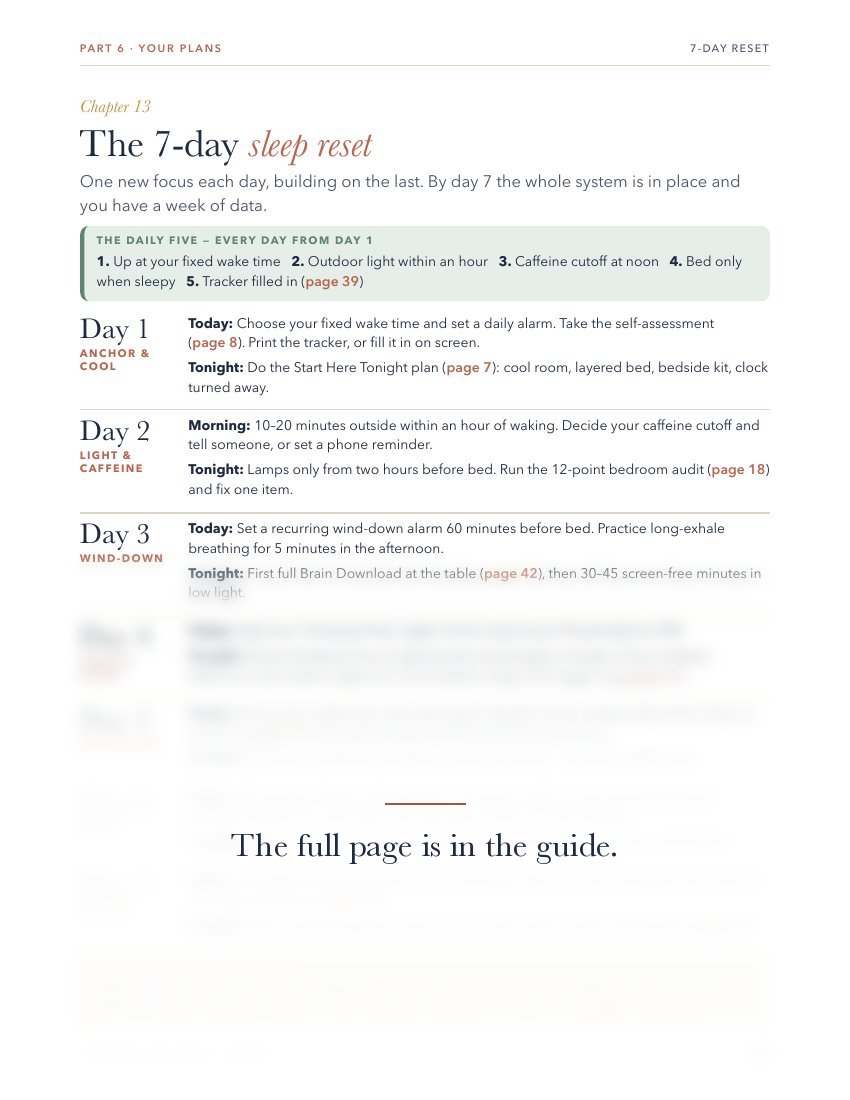
The Brain Download: 10 minutes, on paper
For most racing minds, this is the single most useful part of the evening. The idea is to get your thinking done before your head is on the pillow.
- Sit at a table, at least an hour before bed, with a sheet of paper. Draw two columns.
- In the left column, write everything on your mind: tasks, worries, things you mustn’t forget. One line each.
- In the right column, write the very next small step for each, and when. “Call the doctor’s office, Tuesday 9 AM.” If nothing can be done, write “nothing to do tonight.”
- Close the notebook and leave it outside the bedroom.
Writing down a next step, rather than just listing worries, is what helps. When a thought comes back at 11 PM or 3 AM, you can tell yourself honestly: “It’s on the list.”
Four things to do with your mind in bed
Once the light is off, give your mind a job that’s calmer than planning. Pick one and use it the same way each night.
1. Long-exhale breathing (5 minutes)
Breathe in through your nose for a count of 4, into your belly. Breathe out slowly, through your nose or pursed lips, for a count of 6. Repeat for about five minutes. If 4 and 6 feels like a strain, use 3 and 5. A longer out-breath slows the heart, which helps when your body is tense or your heart is thumping.
2. Progressive muscle relaxation (10 minutes)
Lying down, tense one muscle group firmly (not painfully) for about 5 seconds, then release it all at once and notice the difference for 15 seconds. Work upward: feet, calves, thighs, hips, stomach, hands, arms, shoulders (shrug them to your ears), and face. This works best when the tension is physical: a tight jaw, raised shoulders.
3. The word shuffle (5 to 15 minutes)
Pick a neutral word with no repeated letters, like GARDEN. For the first letter, think of unrelated words (goat, guitar, glove) and picture each one for a few seconds. When you run out, move to the next letter. Random, unconnected images are close to the way the mind drifts toward sleep, and they crowd out planning. Many people don’t reach the end of the word.
4. Rest, without the goal of sleeping
If you’ve started to dread bedtime, take the pressure off. Use the muscle relaxation with the aim of resting, not sleeping. Lying quietly in the dark still counts for something, and trying hard to sleep is one of the surest ways to stay awake.
Which one, when? To-do list starts as soon as you lie down: Brain Download in the evening, word shuffle in bed. Body tense and heart thumping: long-exhale breathing, then muscle relaxation. Anxious about sleep itself: muscle relaxation, with resting as the goal.
If you’re still awake after about 20 minutes
Don’t stay in bed trying harder. If you notice you’re frustrated, or wide awake, get up and go somewhere dim and comfortable: a chair in another room, a low lamp, a blanket, a familiar book. No phone, no email, no chores. Go back to bed when you feel sleepy again.
It feels backward, but it follows the same principle as the rest of this routine: you’re teaching your brain that bed is for sleeping, not for thinking. Keep your wake-up time the same the next morning, however the night went.
What about screens?
The blue light from a phone matters less than headlines suggest. The bigger problems are what you’re looking at (work email, news and arguments wake you up) and the way screens quietly push bedtime later. Choose the best level you can manage on most nights:
- Best: all screens off an hour before bed, with the phone charging outside the bedroom.
- Good: work, email, news and social media off an hour before bed. A calm TV show you’ve seen before, across the room, is fine.
- Minimum: night mode and lowest brightness in the evening, nothing interactive in bed, and audio only once the light is off.
Short on time? The 20-minute version
A short routine done every night does more than a perfect one done twice a week.
- Brain Download, 5 minutes.
- Cool the room, water by the bed, phone across the room, 5 minutes.
- Dim light and a paper book or some stretching, 10 minutes.
Give any new routine about two weeks before you judge it, and change one thing at a time so you can tell what’s helping. Falling asleep often gets easier within the first week, though results vary from person to person.
When to talk to your doctor
A wind-down routine helps with the everyday version of a busy mind. Talk to your doctor if:
- It takes you more than 30 minutes to fall asleep three or more nights a week, and it’s gone on for three months or longer. Ask about cognitive behavioral therapy for insomnia (CBT-I), which sleep-medicine guidelines recommend first for long-running sleep problems. It’s available with a clinician or through digital programs.
- You feel anxious, low or flat most days for two weeks or more, or you’ve lost interest in things you usually enjoy.
- You snore, gasp in your sleep, or wake unrefreshed no matter how long you sleep.
- You get an uncomfortable urge to move your legs in the evening.
- You’re thinking about a supplement or an over-the-counter sleep aid. Check with your doctor or pharmacist first, especially if you take other medications.
If you ever have thoughts of harming yourself, call or text 988, the Suicide & Crisis Lifeline, right away.

If you’d like it all in one place.
The timed evening routine, a fillable Brain Download worksheet and all four switch-off tools, inside a 30-day sleep reset for women after 40.
Get the guide · $19This article is general wellness information for women after 40, written from Vester’s guide Through the Night. It isn’t medical advice and can’t take into account your own history. Results vary.