
Waking at 3 AM after 40: why it happens and what to do.
Falling asleep is fine. Then the clock says 3:12 and your mind is wide awake. Here’s why that happens more after 40, and exactly what to do the next time it does.

You fell asleep without much trouble. Then you’re awake, and it’s dark, and something tells you it’s around 3 AM. You check. It is. Within a few minutes you’re thinking about work, a parent’s appointment, the noise the car is making, and how tired you’re going to be tomorrow.
If this started somewhere in your forties, you’re in very common company. And the good news is in the details: the waking itself is mostly normal. What turns it into an hour or two awake is what happens in the minutes after, and that part is something you can practice.
Waking in the night is normal. Staying awake is a pattern.
Everyone wakes briefly several times a night, at every age. You used to sleep straight through those moments without noticing them. After 40, sleep gets lighter, so more of those brief wakings turn into full ones, and once you’re fully awake your thinking brain switches on.
That’s the useful shift in perspective. The goal isn’t eight unbroken hours. It’s to make night wakings shorter, calmer and less alarming, so that you drift back easily and wake up feeling reasonably rested.
Why 3 AM, specifically?
There’s a reason it’s so often between 2 and 4 AM, and not midnight.
- Deep sleep comes early. Most of your deepest sleep happens in the first part of the night. By 3 AM you’ve used much of it up, the pressure to sleep is lower, and sleep is lighter. Small things that wouldn’t have woken you at midnight now do.
- Your body is starting its morning. Cortisol, the hormone that helps you get going in the morning, begins its rise in the early hours. It doesn’t wake you on its own, but it makes it easier to come fully awake.
- Hormone changes make sleep more fragile. Progesterone has a calming effect on the brain, and it falls in perimenopause. Estrogen swings can trigger night sweats, and many women wake a moment before the heat arrives, so it can feel like a jolt of anxiety rather than a hot flash.
- Alcohol wears off. A glass of wine with dinner can help you fall asleep, then wear off right around 2 to 4 AM, leaving sleep shallow and broken. The same drink also hits harder as we age.
- The 3 AM brain is not at its best. In the middle of the night, the part of your brain that scans for threats is active and the part that reasons is not. Problems look bigger and solutions look fewer. That’s why a worry that seems manageable at lunch can feel overwhelming at 3.
Most women have more than one of these going on at once. That’s why a single tip rarely helps on its own, and why a small, repeatable plan tends to work better.
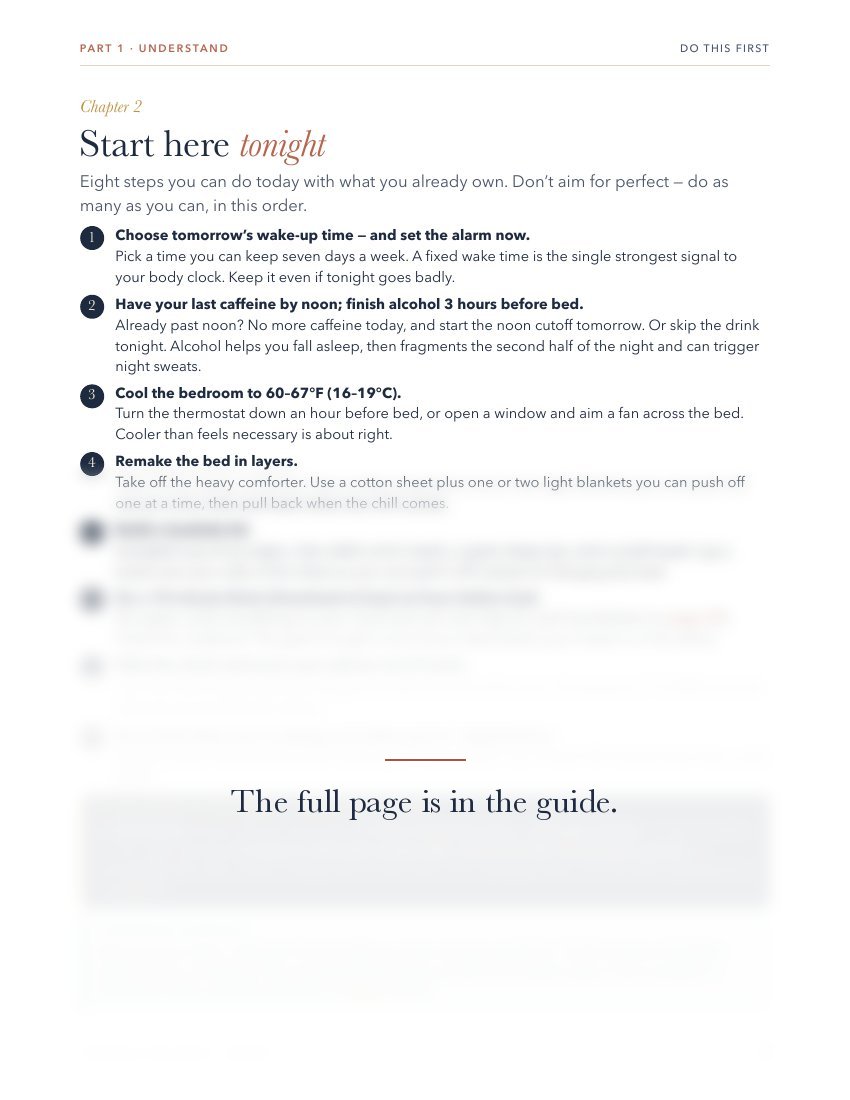
What to do the next time you wake
Follow the same steps every time. Repetition is the point: you’re teaching your brain that waking at night is boring and brief.
- Don’t look at the time. Not the clock, not your phone, not your watch. Knowing it’s 3:12 changes nothing about what you’ll do next, and it starts the arithmetic (“if I fall asleep now I’ll get three hours…”) that wakes you up completely. Turn the clock to the wall tonight and charge your phone across the room.
- Check your body, not your thoughts. Hot? Push the covers off, take a sip of cold water, and let yourself cool down. Need the bathroom? Go, using only a dim night-light, and come straight back. Neither? Stay still with your eyes closed.
- Give sleep a quiet chance. For roughly 15 to 20 minutes, use something that gives your mind a job. Breathe in through your nose for a count of 4 and out slowly for a count of 6. Or try the word shuffle: pick a neutral word like GARDEN, think of unrelated words that start with each letter (goat, guitar, glove…), and picture each one for a few seconds. If you’re calm and drowsy, stay as long as it takes.
- If you’re wide awake, get up. Don’t time it. The moment you notice you’re trying hard to sleep, or getting annoyed, leave the bed. This is the step most people resist, and it’s the one that matters most.
- Go somewhere dim and pleasant. A chair in another room, a low warm lamp, a blanket, and something calm but not gripping: a familiar novel, a crossword, knitting, an audiobook. No phone, email, news, food or chores.
- Go back to bed when you’re sleepy. Heavy eyelids, yawning, rereading the same line. That might be 15 minutes or 50. If you’re awake in bed again for a while, repeat.
- Get up at your normal time anyway. No sleeping in and no long nap. The sleep you lost tonight becomes extra sleep pressure tomorrow night, and that’s what helps your sleep come together over the next week or two.
Why getting up helps. Every hour spent awake and frustrated in bed strengthens a link in your brain between bed and being awake. Leaving the bed breaks that link. This approach, called stimulus control, is one of the best-tested parts of cognitive behavioral therapy for insomnia (CBT-I). It’s tedious for the first few nights. That’s expected.
What to say to your 3 AM brain
You don’t need to win the argument with your middle-of-the-night thoughts. You only need to decline it. Pick the reply that fits, say it once, and go back to your breathing.
- “I’ll be useless tomorrow.” Try: “I’ve managed on short sleep before. Tomorrow will be OK, not great, and I’ll sleep better tomorrow night because of it.”
- “If I fall asleep right now I’ll still only get…” Try: “I’m not doing sleep math. Resting quietly still counts.”
- “I have to figure this out.” Try: “Not with this brain.” Then write one line on a notepad by the bed and leave it for 10 AM.
- A pounding heart or a wave of dread for no clear reason. Try: “That’s a hot flash arriving, or adrenaline. In for 4, out for 6. It passes.”
If it’s nearly morning
If you wake within about 45 minutes of your alarm, don’t fight for scraps of sleep. Get up, keep the lights low until your usual wake time, and start the day gently. Then go to bed at your normal time tonight, not earlier.
If you’re regularly waking at 4:30 and staying up, that’s a slightly different pattern. Often your body clock has drifted earlier or your bedtime has crept earlier. Getting bright light in the early evening and moving bedtime later in 15-minute steps every few nights can help shift it.
What helps during the day
Night wakings get shorter when the day sets up the night. These habits do a lot of quiet work:
- One wake-up time, seven days a week. Pick a time you can keep, weekends included. It’s the strongest signal you can give your body clock, and it matters most after a bad night.
- Outdoor light within an hour of waking. Ten to twenty minutes outside, longer if it’s overcast. Coffee on the porch or a walk both count. Light through a window is much weaker.
- Last caffeine by noon. Caffeine lingers for hours, and lighter sleep is easier for it to disturb. If 3 AM waking is your main problem, this one is worth testing strictly for two weeks.
- A 14-night alcohol-free experiment. Alcohol is one of the most common hidden reasons for waking at 3. Try two weeks without it and compare. If you drink afterward, one drink with food, finished at least three hours before bed.
- Don’t go to bed early to catch up. An 8:30 PM bedtime after a rough night usually buys you a long stretch awake at 3 AM. Go to bed when you’re sleepy, at your normal time or a little later.
- Keep naps short or skip them. If you must, 20 minutes before 3 PM with an alarm. Dozing on the couch in the evening counts as a nap.
Spending far more time in bed than you actually sleep also spreads sleep thin. If you’re in bed nine hours to get six, gently trimming that time can help consolidate sleep. It’s a more structured technique with real side effects, like daytime sleepiness for a week or two, so read up on it properly or ask your doctor first, and don’t try it if you have signs of sleep apnea.
How to tell it’s improving
Progress usually shows up in a particular order. First, waking up feels less distressing. Next, the time you spend awake gets shorter. Later, you start sleeping through some wakings entirely. Most people notice the first changes within one to two weeks of doing the steps every night, though results vary.
Single nights don’t tell you much. A short note each morning, with your rough estimate of how long you were awake (never check the clock in the night to fill it in), shows the real trend over a week.
When to talk to your doctor
Habits help with a lot, but not everything. Book an appointment if:
- You snore loudly, or someone has noticed you gasp, choke or stop breathing in your sleep. Sleep apnea becomes more common after menopause and in women it often looks like frequent waking or exhaustion rather than loud snoring.
- You doze off in the daytime without meaning to, or feel drowsy when driving.
- You get an uncomfortable urge to move your legs in the evening that eases when you walk around.
- You wake twice or more a night to use the bathroom.
- Night sweats wake you most nights, or they’re new, drenching, and come with fever, weight loss or swollen glands.
- Your mood has been low or flat most days for two weeks or more. Early waking can be a sign of depression, which is more common during the menopause transition.
- You’ve slept badly three or more nights a week for three months, even with good habits in place.
Chest pain or trouble breathing: call 911. If you ever have thoughts of harming yourself, call or text 988, the Suicide & Crisis Lifeline.

If you’d like it all in one place.
The full 3 AM plan, the replies to your 3 AM brain, a night-nest checklist and a tracker to see what’s changing, inside a 30-day sleep reset for women after 40.
Get the guide · $19This article is general wellness information for women after 40, written from Vester’s guide Through the Night. It isn’t medical advice and can’t take into account your own history. Results vary.