
The 3 PM crash after 40: why it happens and what helps.
Mornings are workable. By mid-afternoon you could put your head on the desk, and the coffee or cookie you reach for sets up the next crash. Here’s what’s going on, and a plan for tomorrow afternoon.

It’s a little after 2. Lunch was fine. Now the screen is swimming, you’ve read the same email three times, and the only thing that seems like it would help is a latte or something sweet from the kitchen. You have one. It works for forty minutes. By 4:30 you’re lower than before.
If this has crept up on you in your forties, you’re not lazy and nothing is wrong with your willpower. The afternoon dip is real, everyone has one, and several things that change in midlife make it deeper. The good news is that most of what decides the size of your 3 PM wall happens earlier in the day, which means you can do something about it before it arrives.
The dip is built in. The crash isn’t.
Your body clock has a natural low point in the early afternoon, usually somewhere between 1 and 4 PM. You can’t delete it. What you can change is how deep it goes and how long it lasts, and after 40 a few things tend to pile on top of it:
- A lunch that spikes your blood sugar. Pasta, a white-bread sandwich or a sweet drink raises blood sugar quickly and lets it fall just as fast. When that drop lands on the body clock’s dip, the two together feel like exhaustion.
- A morning that started with toast and coffee. Too little protein at breakfast sets up an 11 AM slump, which leads to a snack, which sets up the 3 PM wall.
- A short or broken night. Lighter, more broken sleep is common in your forties, and a poor night turns the normal dip into a wall. If 3 AM wakings are part of the picture, they’re part of the afternoon too.
- Less muscle and less movement. Muscle uses sugar from your blood. After 40 we gradually lose it unless we work to keep it, and a desk day gives it little to do.
- The fix that feeds the problem. The 3 PM coffee borrows from tonight. Half of it is still in your system at 9 PM, so the night gets shallower, the morning gets harder and tomorrow’s dip gets deeper.
Start at breakfast and lunch
The size of the 3 PM wall is mostly decided at 12:30, and partly at 7:30.
- Breakfast with real protein, within two hours of waking. Aim for roughly 25 grams: 3 eggs, a cup of Greek yogurt or cottage cheese, or beans on toast. Not hungry that early? Eat half now and the rest at 10. Have your coffee after it, not instead of it; caffeine on an empty stomach gives a bigger jolt and a bigger drop.
- Build lunch around protein, vegetables and slow carbs. Roughly half the plate vegetables, a quarter protein, a quarter slow carbs like beans, lentils, whole grains or potatoes with the skin. Chicken salad with beans and fruit, lentil soup with whole-grain bread, last night’s leftovers.
- Not at the desk. Ten minutes away from the screen. Eating fast and distracted makes the blood sugar spike higher.
- Don’t skip it. Skipping lunch because you’re busy is the fastest route to a 4 PM sugar binge. Keep something ready: boiled eggs, hummus and vegetables, a tin of beans, yogurt and nuts.
Most women eat nearly all their protein at dinner, which is the worst arrangement for a steady afternoon. Spreading it across three meals does more for the afternoon than any supplement.
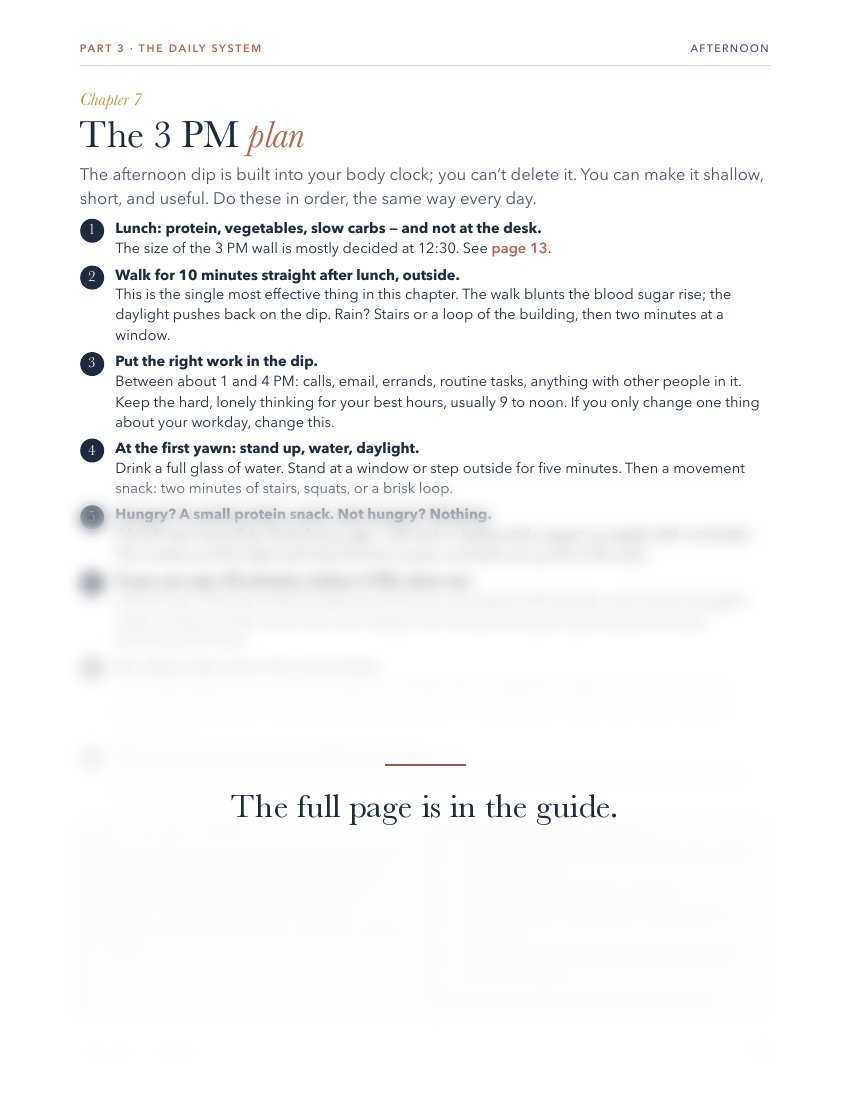
The 3 PM plan
Do these the same way every day. Repetition is what makes them automatic.
- Walk for 10 minutes straight after lunch, outside. If you only do one thing, do this. Working muscles pull sugar out of your blood, which blunts the after-lunch spike and the slump that follows it, and early-afternoon daylight raises alertness directly. Ten minutes is enough; twenty is better. Raining? Stairs or a loop of the building, then two minutes at a window.
- Put the right work in the dip. Between about 1 and 4 PM, do calls, email, errands, routine tasks and anything involving other people. Save the hard, lonely thinking for your best hours, usually 9 to noon.
- At the first yawn: stand up, water, daylight. A full glass of water, five minutes at a window or outside, then two minutes of stairs, squats or a brisk loop.
- Hungry? A small protein snack. Not hungry? Nothing. If lunch was more than three hours ago: nuts and a cheese stick, yogurt, or an apple with nut butter, under about 200 calories.
- If you can nap: 20 minutes, before 3 PM, alarm set. A short nap in the dip restores alertness for hours and won’t touch tonight’s sleep. Longer or later, and it will. Can’t sleep? Ten minutes with your eyes closed and slow breathing still helps.
- No coffee after noon. Yes, even today. Herbal tea, sparkling water or a cold glass of water with lemon do the “ritual” part of the afternoon cup.
Why the work matters as much as the food. Trying to do your hardest thinking in the dip feels like wading through mud, and it pushes you toward caffeine and sugar to get through it. Moving that work to the morning, and giving the afternoon to tasks that run on autopilot or on other people, often helps more than anything you eat.
What not to reach for
- The 3 PM coffee. Caffeine reliably improves alertness. The problem is timing: what it gives you at 3 PM it takes back at 2 AM. For a 10 to 10:30 PM bedtime, the last cup belongs before noon. More on that in coffee and wine after 40.
- The cookie, the candy, the sweet drink. They feel like the answer and they work briefly, then set up the 4:30 crash.
- Energy drinks and “energy shots.” Caffeine plus sugar plus other stimulants in amounts you often can’t see. The sugar crash and the late caffeine both deepen the afternoon problem they’re sold to solve.
- A long nap or an early night to catch up. An hour on the couch at 5 or bed at 8:30 after a rough day tends to buy you a broken night and a deeper dip tomorrow.
Track one number
Memory exaggerates bad days. For two weeks, rate your energy from 1 to 5 three times a day: when you wake, at 3 PM and at 8 PM. It takes ten seconds.
The 3 PM score is the one to watch, because it usually moves first. Most people who change lunch and add the walk see it rise within one to two weeks. Results vary, and a single day doesn’t tell you much. A week of numbers will also show you your best hours, which is useful information for planning your work.
When to talk to your doctor
An afternoon dip is normal. Some patterns are worth checking. Book an appointment if:
- You fall asleep without meaning to: at your desk, as a passenger, or worse, at the wheel.
- The dip starts at 10 AM, not 2 PM, or you’re tired all day with no peak at all.
- The crash comes with a racing heart, shakiness or sweating, or with unusual thirst.
- You’re breathless on stairs, feel cold when others don’t, or your periods are heavy. Iron deficiency is common in perimenopause and can be missed by a routine blood count; ask for a ferritin test.
- You snore, gasp in your sleep, or wake with headaches and a dry mouth.
- Your mood has been low or flat most days for two weeks or more.
- You’ve changed your lunch, walked after it and moved your coffee for two weeks, and nothing has shifted.
Some medications cause tiredness too; ask your doctor or pharmacist about timing or alternatives, and never stop a prescription on your own. Chest pain, trouble breathing or fainting: call 911.


For the night and the day.
Daylight, the 30-day energy reset with the full 3 PM plan, lunch ideas and an energy tracker, together with Through the Night, both workbooks and the Audio Wind-Downs.
Get the package · $39This article is general wellness information for women after 40, written from Vester’s guide Daylight. It isn’t medical advice and can’t take into account your own history. Results vary.